Is a Lunch Subscription Plan Actually Worth It in Lagos? An Honest Breakdown
This is a fair question, and it deserves a fair answer — not a sales pitch dressed up as a blog post. So here's the actual math, using real prices, not guesses.
The Real Comparison
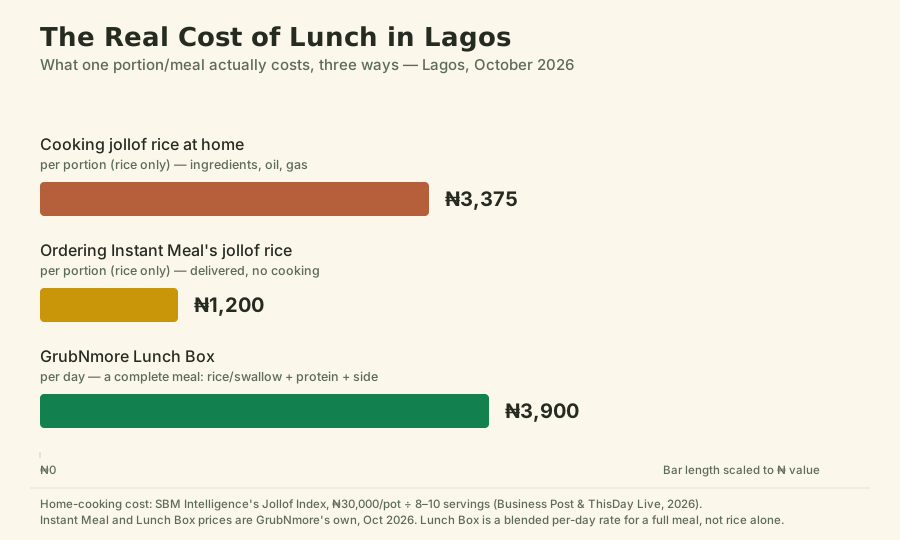
Cooking at home. SBM Intelligence's Jollof Index — reported by Business Post and ThisDay Live — found that cooking a pot of jollof rice at home now costs close to ₦30,000, a 624% rise over ten years driven by food inflation. Split across 8–10 servings, that's roughly ₦3,000–₦3,750 per portion — for rice alone, before protein, before the gas, before your time standing over a stove.
Ordering it already made. GrubNmore's own Instant Meal jollof rice quick-pick costs ₦1,200 per portion — genuinely cheaper than cooking the same portion of rice at home right now. That's not a marketing claim, it's the same sourced data point that's already live on the jollof cost guide.
A full day's lunch, subscribed. GrubNmore Lunch Box works out to roughly ₦3,800–₦4,000 per day depending on the plan — but that figure buys a complete lunch: a swallow or rice dish, a real protein, and a side, not rice on its own.
So What's the Honest Verdict?
If you're only comparing rice to rice, cooking at home has gotten surprisingly expensive — expensive enough that ordering it ready-made is now the cheaper option, which is the kind of thing that sounds backwards until you look at the actual ₦30,000-a-pot number. But lunch isn't rice alone. Once you add a real protein, oil, seasoning, and the cooking gas a full Nigerian lunch actually needs, a home-cooked lunch easily reaches or passes what Lunch Box charges for a complete, already-made meal — and that's before counting the half hour (or more) of your own time it takes to get there.
Where a subscription genuinely wins: you're not weighing portions, you're weighing certainty. A subscription means lunch is already decided, already paid for, and already on its way — which has real value on a workday, separate from the naira math.
Where it doesn't automatically win: if you only eat lunch out two or three days a week, or you genuinely enjoy cooking and don't count your time, the math is closer and the decision comes down to convenience, not savings.
The Honest Recommendation
If lunch is a daily, five-day decision you're tired of making, a subscription at ₦20,000/week (or ₦76,000/month, which works out cheaper per lunch and includes one free) is a real, defensible trade — not just against restaurant prices, but against what a full home-cooked lunch now genuinely costs in Lagos.
Does This Math Apply Wherever You're Based?
The Lunch Box side of this comparison applies directly if you're in Ikoyi, Victoria Island, Lekki Phase 1, Lekki Phase 2, Ajah, or Chevron — that's the subscription's real delivery zone. If you're further out — Oniru, Ikate, VGC, Agungi, Igbo-Efon, Ologolo, or Jakande/Osapa London — the home-cooking-versus-ordering math still holds, but the "subscribed" column becomes Instant Meal ordered daily rather than Lunch Box, since those areas sit outside Lunch Box's zone for now. Either way, the underlying numbers — what cooking a portion of rice actually costs today versus ordering it — don't change by neighborhood.
FAQ
Is cooking at home always more expensive than ordering?
Not always — this comparison is specifically rice-for-rice, using a real, cited cost index. Other dishes and household sizes will land differently; the point is that "cooking is obviously cheaper" isn't a safe assumption anymore.
Does the Lunch Box price include delivery?
Yes — both the Weekly and Monthly plans include delivery within the Lunch Box zone (Ikoyi, VI, Lekki Phase 1 & 2, Ajah, Chevron).
What's the real saving on the Monthly plan versus Weekly?
₦76,000 for 20 lunches works out to roughly ₦3,800/lunch, against ₦4,000/lunch on the Weekly plan — plus the Monthly plan includes one lunch free.
See This Week's Lunch Box Menu
Compare the real weekly menu and sign up for Weekly or Monthly.
See the Menu →